 Term Life Insurance
 Permanent Life Insurance
 No Medical Life Insurance Canada
 Critical Illness Insurance
 Mortgage Life Insurance
 Guaranteed Issue Life Insurance

Quick Answer
When comparing Term 10 vs Term 20 vs Term 30 life insurance, the main difference is how long the initial premium is set before renewal. This means that for a 10 year term insurance plan the premium that you are quoted will be in effect for the first ten years of the policy. Likewise, with 20 and 30 year term insurance plans the initial premium is set for that length of time. At the end of the initial term the policy may be considered ‘guaranteed renewable’; which means that the coverage stays in force regardless of any changes in your health, but the premium will increase. What this results in is that the initial premium will be the cheapest for 10 year term insurance for the first ten years. If you are looking at the coverage for a way to offset your mortgage or income replacement for a young family you may want to consider 20 or 30 year term insurance because, although the first ten years have a lower premium, if you calculate the cost including renewals the longer term plans will be a much lower cost over the time period that you need the coverage.
Table of Contents
- Quick Answer
- What is Term Life Insurance?
- Why Many Canadians Choose Term Insurance Over Permanent Insurance
- Term 10 vs Term 20 vs Term 30: Quick Comparison
- Comparing Term 10 vs Term 20 vs Term 30 Life Insurance in Canada
- Common Term Length Choices by Life Stage
- Important Tradeoffs to Consider
- Monthly Cost Comparison
- Estimated Cost Difference Over Time
- How Much Term Insurance Coverage Is Common in Canada?
- Family Life Insurance Needs Analysis Worksheet
- Compare Term Coverage Options
- Which Term Length Is Best for Your Situation?
- Singles
- Couples
- Young Families
- Mortgage Protection
- Canadians Nearing Retirement
- Advisor Insight
- What Happens When a Term Policy Expires?
- Key Canadian Statistics & Insurance Trends
- Frequently Asked Questions
- Key Takeaways
- Conclusion
- About the Author
What is Term Life Insurance?
Term life insurance is a very important product in protecting the financial well being of many Canadian Families. Term life insurance provides life insurance coverage for a specified number of years, like 10, 20 or 30, known as the term of the policy. Your beneficiaries have death benefit protection if the premiums are paid up and you pass away during the term. Since the coverage is for a set number of years it is ideal for Canadians to use term life insurance to cover temporary needs, like their mortgage, replacement income or supplementing child care expenses. Some term policies may be guaranteed renewable as well, meaning that at the end of the term, you may continue the coverage, but with a higher premium associated with it for the next 10, 20 or 30 years. The increase in premiums is one major difference from permanent life insurance. The other difference is that most term insurance policies have an age at which they expire. Typically around age 85. This means that if you had a term plan and live past that age you no longer have the coverage.
Why Many Canadians Choose Term Insurance Over Permanent Insurance
When you need life insurance you should be carrying out something called a needs analysis to help you determine how much coverage you need. As part of this needs analysis you should also determine what is a permanent need and what is a temporary need. When you are done with your needs analysis you should be looking at purchasing a term life insurance policy to offset the financial impact associated with temporary needs. Temporary needs are expenses that go away over time, so things like your mortgage or having a young family to supplement income for are great examples of needs that you would cover with term life insurance. Many Canadians choose term life insurance over permanent life insurance for covering their large, temporary needs, because the premium is lower than permanent insurance for covering the need, allowing for larger death benefits being accessible to the owner.
Term 10 vs Term 20 vs Term 30: Quick Comparison
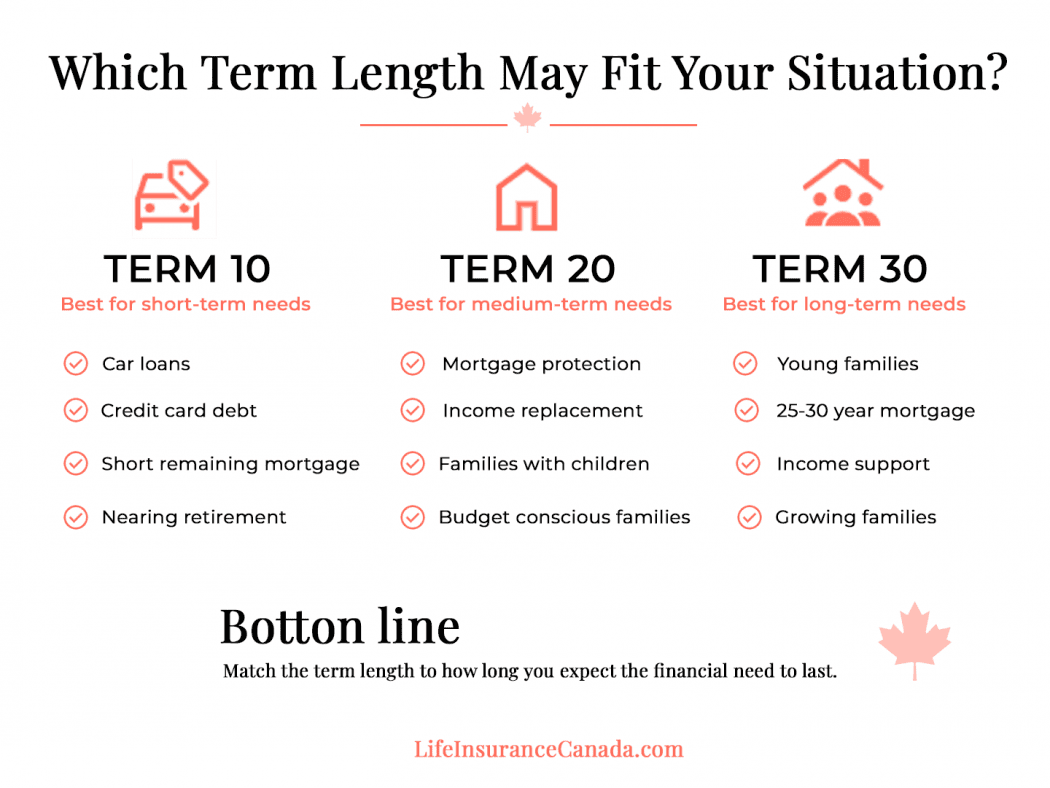
The main difference in all term policies is the length of the term. That applies to how long the initial premium is set before the policy reaches its renewal point. Typical term lengths in Canada are ten, twenty or thirty years. Each term has unique strengths where they shine as solutions for protecting the financial security of your family. Here is a comparison of term 10, term 20 and term 30 life insurance that outlines the differences.
Comparing Term 10 vs Term 20 vs Term 30 Life Insurance in Canada
- Lower monthly premiums: Since the coverage is for a set number of years, think 10, 20 or 30 years, the insurer can manage the risk differently. We know that everyone dies, but not everyone dies within the next 10 years (for example). This allows the insurer to look at risk differently. Since they are only covering you for the set amount of years of the term it allows lower premiums to be paid for coverage compared to what you would pay trying to get the same death benefit from permanent life insurance.
- Higher coverage for cheaper cost: Again, this comes down to risk management from the insurer. Since the risk they are taking on is you dying during the term the risk is lower to the insurer. This allows them to have a lower ‘unit cost’ for the coverage. Premiums for term life insurance are also a more ‘pure’ form than permanent coverage. There is no cash value component for term life insurance so you aren’t funding any future values in the policy, making what you pay in premium a more accurate reflection of what the true risk is during the next 10, 20 or 30 years of the term.
- Popular for families: Since many of the expenses that families, particularly young families, face are large, but also temporary, the best way to deal with these needs is to use term insurance. Since you get higher amounts of coverage for lower premium amounts than a permanent insurance plan, term life insurance is the best way for families to make sure that they are able to meet the financial need associated with someone passing away unexpectedly.
- Flexible terms lengths: This is one of the things that makes term life insurance really valuable in solving your needs. Since it comes in a variety of term lengths you can match the length of the coverage to the length of the need that you have. So if you have an expense you want covered that will be paid off in the next ten years, you can use a 10 year term insurance plan to offset that. Likewise for longer lasting expenses. Using 20 year term insurance or 30 year term insurance for those longer term needs allows you the best efficiency when it comes to premium dollars invested in your financial security plan.
- Good for income replacement: Income replacement is a huge need for anyone with a family, but of particular importance to young families. Imagine you and your spouse have a new baby at home and the worst case scenario happens and one of you passes away. You have just become a single income household. If you planned your insurance well you would have included an amount to help supplement that single income, but this is a need that goes away. The amount of income your spouse needs to help raise a new born is dramatically different from the amount needed for an 18 year old. This is where the larger amount of death benefit in a 20-year term insurance plan can be a great fit. You get the coverage your family needs for the amount of time that they need it.
- Protects your mortgage payments: Mortgages are another large, but temporary debt that many Canadians face. Rather than paying a large premium for permanent coverage on an expense like a mortgage where the debt shrinks over time many Canadians choose to use term life insurance to protect against this debt. This is also a better solution than the lenders ‘mortgage life insurance’ because the death benefit is payable to your beneficiaries, not to the lender, so they are free to do as they please with the money rather than having it automatically applied to paying off your mortgage.
- Fits short term needs: When compared to permanent life insurance the premiums for term coverage are significantly more affordable. This makes term life insurance an ideal solution for covering a need that is short term in nature. Why pay extra premiums for permanent insurance to cover a need that you won’t need in 10 years?
| Feature | Term 10 | Term 20 | Term 30 |
| Coverage Length | 10 years | 20 years | 30 years |
| Monthly Premium | Lowest | Moderate | Highest |
| Premium Stability | Short-term | Medium-term | Long-term |
| Renewal Cost | Increases sooner | Increases later | Delayed longer |
| Best For | Temporary needs | Families and mortgages | Long-term protection |
| Typical Buyer | Older Canadians | Parents and homeowners | Young families |
| Mortgage Protection | Short mortgage | Standard mortgage | Long mortgage |
| Good for Young Families | Limited | Strong | Strongest |
| Good Near Retirement | Sometimes | Less common | Rare |
| Most Common Choice in Canada | Moderate | Most common | Growing popularity |
| Ideal Age Range | 50+ | 30s-40s | 20s-40s |
| Best Advantage | Cheapest premium | Balance of cost and protection | Longest premium stability |
| Biggest Drawback | Renewals become expensive | More expensive than term 10 | Highest monthly premium |
Comparison table of Term 10, Term 20 and Term 30 life insurance in Canada.
Quick Summary
What you can see from the comparison is that the key to getting the most from your term life insurance is to try and match the length of the need with the length of the term. The more closely you are able to do this the more cost effective your life insurance coverage will be while still meeting your needs. The reason that you try and match the term length with the time frame of the need is that renewal points increase the premium so if you cover a 30 year need with a 10 year term plan it will renew twice and will end up costing you significantly more than you would have paid had you used a 30 year term policy.
Common Term Length Choices by Life Stage
| Life Stage | Common Choice | Why |
| Single, no children | Term10 | This will cover you for debts like credit cards and student loans that are short term in nature. They still need to be paid if you pass away so you don’t want to leave a large bill for your loved ones. |
| Young family | Term 20 | There is a significant financial burden if your income is lost for a young family but that burden eases as the children age. Match the term length to the point where your children will be able to be self-sufficient. |
| New homeowner | Term 20 or 30 | Typically a mortgage carries a 25-30 year amortization so you want to match the length of the term to that to avoid overpaying as you age and shorter term length policies force you to pay higher renewal premiums. |
| Young children under 5 | Term 30 | With a young family you face the fact that if your income was lost the surviving parent faces the potential of real financial hardship. Having 30 years where your partner is protected against the loss of your income eases the stress of this. |
| New retirement | Term 10 | Many people are entering retirement with debt in today’s economic climate. Pair this with the loss of any workplace benefits that included life insurance and you may want to have some extra insurance for the short term at the start of your retirement. |
Important Tradeoffs to Consider
It is important to understand the impact that renewal points will have on the cost of your insurance. This may sound like I am being a smart Alek but one thing I know for sure for everyone that I meet is that 10 years from now they are ten years closer to the end of their life. I also know that the odds that something happens to them in the ten to twenty year window in the future are higher than they are in the next ten years. With this in mind, this is why term insurance renewal premiums aren’t linear. Each one will be larger than the last one simply because the odds that something happens to you in the next term period are higher than the previous one.
- Term 10: Term 10 policies will have the lowest year one premium because the time frame until the first renewal is the shortest. Coverage for 10 years and then the policy renews makes this the type of policy that Canadians choose for short term needs like car loans or credit card debt.
- Term 20: Term 20 policies will have a higher initial premium than a 10 year term plan. The trade off is that since they don’t have a renewal at year 10, the premium for years 10 thru 20 tend to be significantly less premium than a 10 year term insurance plan after its renewal. This makes the net cost of insurance over 20 years much lower than using a ten year term insurance plan to cover a need like a mortgage that will be around for 20 years.
- Term 30: With the highest initial premium you need to stay focussed on the reason that you have the insurance for a term 30 plan. By using a term this long you avoid at least one, or possibly two renewal points. This makes the net cost at the end of the 30 years significantly lower than the shorter term policies. Commonly you see the 30 year term insurance plan put in place with people who have young children or 30 year mortgages.
Monthly Cost Comparison
Ten year term insurance will be the cheapest option when you look at the initial premium. This is because of the point covered earlier where I outlined how the insurer being able to increase the premium at renewal points makes a big difference to them. We are talking about experts at risk management when we look at insurers. They know that if they look at someone who is healthy today, the odds that something goes wrong with their health or they pass away unexpectedly increases every year. Now when you consider risk management that way you can see why if they are setting the premium for ten years compared to setting it for 30 years they can make the ten year rate much lower. The tradeoff for many policy owners comes down to getting the amount of coverage they need. Many people are caught between being able to afford the premium and the amount of death benefit that their needs analysis said they should have. If this is the case for you I would always lean towards getting the amount of coverage you need because if something happened to you tomorrow your beneficiaries are much better off having needs covered.
Monthly Cost Comparison for Male Applicants
| Age | Coverage Amount | Term 10 | Term 20 | Term 30 |
| 30 | $250,000 | $13.94 – $38.93 | $15.98 – $42.75 | $25.65 – $34.65 |
| 30 | $500,000 | $20.25 – $72.45 | $27.90 – $80.10 | $42.75 – $59.40 |
| 30 | $1,000,000 | $35.10 – $75.60 | $48.60 – $97.20 | $74.70 – $111.60 |
| 40 | $250,000 | $14.85 – $42.30 | $26.77 – $159.53 | $48.11 – $61.65 |
| 40 | $500,000 | $26.99 – $79.20 | $43.65 – $89.55 | $85.05 – $112.95 |
| 40 | $1,000,000 | $46.80 – $91.80 | $78.30 – $129.60 | $143.10 – $218.70 |
| 50 | $250,000 | $36.44 – $81.00 | $68.85 – $233.33 | $128.24 – $155.03 |
| 50 | $500,000 | $57.05 – $156.60 | $112.83 – $233.10 | $218.25 – $303.30 |
| 50 | $1,000,000 | $105.53 – $191.70 | $209.70 – $348.30 | $388.80 – $600.30 |
Monthly premiums shown for male applicants, actual rates will vary by applicant and insurer.
Monthly Cost Comparison for Female Applicants
| Age | Coverage Amount | Term 10 | Term 20 | Term 30 |
| 30 | $250,000 | $10.58 – $25.88 | $12.60 – $74.25 | $19.13 – $23.63 |
| 30 | $500,000 | $13.95 – $46.35 | $19.80 – $51.30 | $31.50 – $39.60 |
| 30 | $1,000,000 | $22.50 – $59.40 | $32.85 – $72.90 | $54.00 – $72.00 |
| 40 | $250,000 | $11.70 – $34.88 | $20.02 – $131.40 | $36.00 – $45.00 |
| 40 | $500,000 | $18.00 – $64.35 | $32.40 – $74.70 | $62.10 – $83.25 |
| 40 | $1,000,000 | $31.05 – $73.80 | $55.80 – $95.40 | $110.70 – $159.30 |
| 50 | $250,000 | $25.88 – $65.48 | $47.24 – $208.35 | $92.25 – $109.13 |
| 50 | $500,000 | $44.55 – $125.55 | $80.11 – $164.70 | $155.54 – $211.50 |
| 50 | $1,000,000 | $74.70 – $152.10 | $139.50 – $246.60 | $279.00 – $412.20 |
Monthly premiums shown for female applicants, actual rates will vary by applicant and insurer.
Monthly Cost Comparison for Joint Applicants
| Age | Coverage Amount | Term 10 | Term 20 | Term 30 |
| 30 | $250,000 | $24.74 – $64.81 | $28.58 – $179.78 | $44.78 – $58.28 |
| 30 | $500,000 | $34.20 – $118.80 | $47.70 – $131.40 | $74.25 – $99.00 |
| 30 | $1,000,000 | $57.60 – $135.00 | $82.80 – $170.10 | $128.70 – $183.60 |
| 40 | $250,000 | $26.55 – $77.18 | $46.79 – $290.93 | $84.15 – $106.65 |
| 40 | $500,000 | $46.78 – $143.55 | $76.50 – $164.25 | $147.15 – $196.20 |
| 40 | $1,000,000 | $80.10 – $165.60 | $134.10 – $225.00 | $253.80 – $378.00 |
| 50 | $250,000 | $63.53 – $146.48 | $116.55 – $441.68 | $220.69 – $263.26 |
| 50 | $500,000 | $102.34 – $282.15 | $192.94 – $397.80 | $380.25 – $512.55 |
| 50 | $1,000,000 | $190.62 – $343.80 | $349.20 – $594.90 | $667.80 – $1,012.50 |
Monthly premiums shown for joint applicants, actual rates will vary by applicant and insurer.
Disclaimer: Term rates shown are for comparison purposes only. Actual premiums vary based on health, smoking status, insurer, underwriting and policy type.
Estimated Cost Difference Over Time
Example: 30 year old male, Non-smoker $500,000 coverage
| Policy Type | Example Monthly Premium | Estimated Cost During Initial Term |
| Term 10 | $20.25 – $72.45 | $2,430 – $8,694 over 10 years |
| Term 20 | $27.90 – $80.10 | $6,696 – $19,224 over 20 years |
| Term 30 | $42.75 – $59.40 | $15,390 – $21,384 over 30 years |
Actual premiums vary based on age, health, smoking status insurer and underwriting.
How Much Term Insurance Coverage Is Common in Canada?
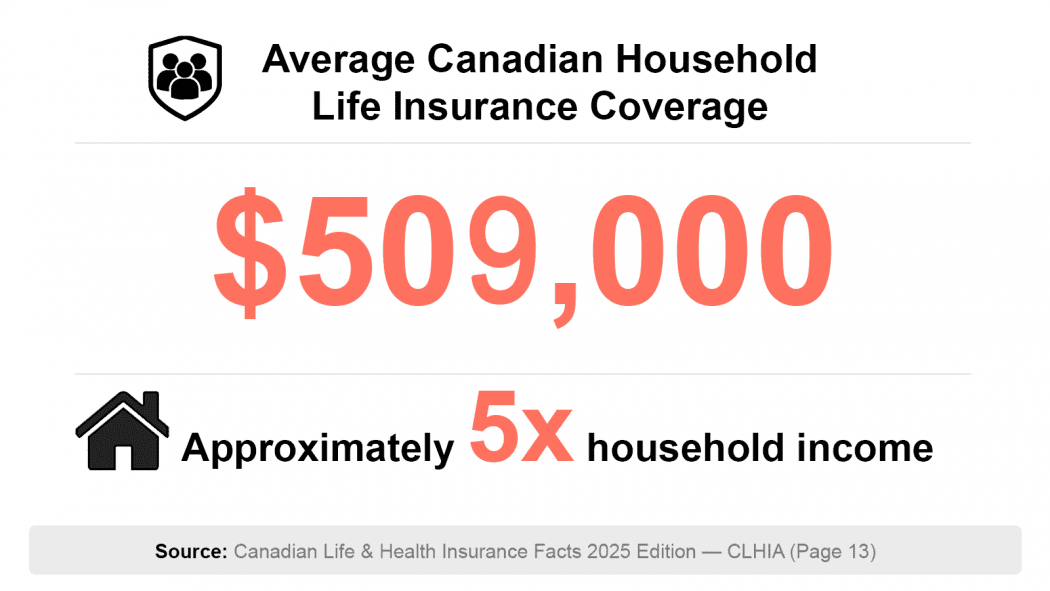
According to the Canadian Life and Health Insurance Association (CLHIA), the average life insurance protection per Canadian household reached approximately $509,000 in 2024, representing roughly five times household income.
Source: Canadian Life & Health Insurance Facts 2025 Edition — CLHIA (Page 13)
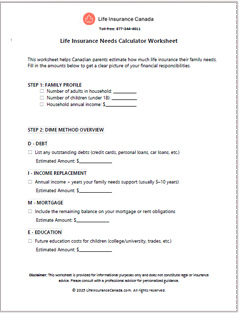
Family Life Insurance Needs Analysis Worksheet
Estimate how much life insurance your family may need. Use this worksheet to add up debts, income replacement, mortgage, education and other family costs.
- Download the PDF.
- Fill in the numbers that apply to your family.
- Bring it to an independent broker or use our quote tool to compare coverage options.
Download PDF: Life Insurance Needs Analysis Worksheet
Compare Term Coverage Options
Term Insurance Quote Tool
Which Term Length Is Best for Your Situation?
Singles
If you are single there can still be a need for life insurance that term life insurance plans can fill nicely. If you own a vehicle and have a loan for it, if you have outstanding student debt or if you have a mortgage that you don’t want to burden your next of kin with figuring out how to deal with then a term insurance plan can be a great solution for you.
| Situation | Common Choice | Why |
| Single renter with no dependents | Term 10 | A policy that covers short term debts like car loans or student loans to ensure that the funds are there to pay the debt off if you pass away. |
| Single homeowner | Term 20 | Since you have likely entered a mortgage a 20 year term is the best solution because you want to try and match the length of the term with the lifespan of the debt. |
| Single business owner | Term 20 or 30 | This can protect your business so that in the event that you pass away unexpectedly there is money in hand to continue while options regarding the future of the business (i.e. selling it or wrapping it up) can be considered |
| Single parent | Term 20 or 30 | The longer term plans again line up with the length of the financial need. In the case of being a single parent, if something happened to you while your children are still depending on you then you need to have a plan in place to help support your children until they are adults. |
| Single Nearing retirement | Term 10 | If you are nearing retirement and have short term debts that you want to make sure that there are funds to pay them off then a ten year term insurance plan is a great fit that will be your most cost effective solution. |
Couples
When you are part of a couple you have someone else to consider what would happen to if you die. For this reason Canadian couples will often use term life insurance to help protect shared mortgages, household income and long-term financial obligations.
| Situation | Common Choice | Why |
| Newly married couple | Term 10 | If you don’t yet have a home or children but are newly married you do have a partner who you will plan to build a future with. A big part of that plan is having two incomes to support goals and dreams. Having a term 10 life insurance policy allows you to make sure that those goals don’t need to disappear if someone passes away unexpectedly. |
| Couple buying a home | Term 20 | Using term 20 insurance to cover a mortgage is the best way to offset that debt. The term length closely matches the length of the debt so it is the best way of offsetting the cost of an unexpected death. |
| Dual income couple | Term 20 | Again we are focussing on matching the length of the term with the time that you will need it. If you are part of a dual income couple it is important to plan for how you would supplement the income for the surviving spouse if you weren’t around any longer. Term 20 is a great choice for this because by the time you are 20 years into your financial plan the need for both incomes is reduced because of the savings that have accumulated. |
| Single income household | Term 30 | In a single income house it is important to provide a longer supplement to replace lost income or to help offset the cost of the loss of the person who doesn’t work outside the home. The need here will be longer because with only one income the build up of savings may be slower. Also, if it is the non-income earner that passes away the need for the survivor to return to work will exist and there may be a need for the surviving partner to pay for help with the role that the deceased had in running their home. |
| Couple nearing retirement | Term 10 | If you are at the point where retirement is imminent you still need some protection for lost income. If you are forced to begin to draw from your savings sooner than you expected or are unable to save as much as you had planned on it will have a negative effect on your plan. A term 10 life insurance policy helps to prevent these situations from arising. |
Young Families
When you are a young family you have things to consider like protecting your children, your household income, funding future education costs and long-term financial obligations. This is why you often see young families look at longer term lengths for the policies that they take out.
| Situation | Common Choice | Why |
| New parents | Term 30 | There will be a common theme for all of these reasons why. That theme is making sure that the length of the term matches the length of the need. If you are new parents it is completely reasonable to estimate that for the next 25-30 years you will face higher expenses based on supporting your children as the grow up. This is why a Term 30 life insurance policy makes sense. |
| Family with young children | Term 30 | Again here we are matching term length to the years that the need will exist for. With young children plans need to be made to make sure that their lifestyle is sustainable even if one of the parents passes away. The term 30 makes sense because this will provide that type of protection until the children are adults and have established their own lives. |
| Growing family | Term 30 | With a growing family what you see is that with every new arrival the clock on how long you need the coverage resets. This is why if you plan on having a large family a term 30 plan that is in place from when the first child is born will provide you with the coverage you need as your family grows. |
| Budget conscious family | Term 20 | While 30 years is a great term length, it is also going to be the policy with the highest premium for the death benefit amount your needs analysis reveals. One thing that you should never do is compromise the death benefit amount. If your budget won’t fit the term 30 premium look at how much a term 20 plan is. Twenty years will still get you through the bulk of time that your family is growing up and will have a more affordable premium for the death benefit you need. |
| Family with large household expenses | Term 20 or 30 | If you face large expenses like education funding and income replacement you need to make sure that these are not a concern if the worst case scenario happens. The best way to manage these are with term 20 or term 30 life insurance to make sure that you match the length of time you need the coverage for with the length of the term. |
Mortgage Protection
As we have discussed already, many Canadians match term length to mortgage timelines and long-term debt obligations. This is because it allows them to budget for their insurance premiums for the length of time that the obligation exists. With rising housing costs and longer mortgage amortizations we are seeing more and more examples of longer terms being used to cover these debts.
| Situation | Common Choice | Why |
| 10 years remaining | Term 10 | When you are in the home stretch of your mortgage and within 10 years of having it paid off you can confidently use a term 10 policy to cover the remainder of the debt. |
| 10-20 year mortgage | Term 20 | Again, matching the remaining time on your mortgage to the length of the term policy matters. If you are more than ten years from paying off your mortgage a term 10 policy will have a renewal where the premium increases. In most cases (unless you are just over 10 years left on the mortgage) that renewal that you pay will make it so that it would have been more cost effective to use the term 20. |
| New 25-30 year mortgage | Term 30 | If you have just entered into a new mortgage you will have a 25-30 year amortization on it. With the focus on the amount of premium that you pay over the lifetime of the need, taking out a term 30 plan and not facing one or two premium increases will make the most sense for you. |
| Shared mortgage with spouse | Term 20 or 30 | If there are two incomes paying your mortgage you need to remember that if one of those incomes is gone the mortgage amount doesn’t drop by 50%. Matching the length of the term to the amortization on your mortgage means that you know that your spouse will be able to pay the mortgage every month. |
| Large mortgage balance | Term 30 | With the increase in home prices that we have seen in recent years many more people are facing the fact that their mortgage payment is higher and doing something that was considered as easy as making accelerated biweekly payments now may not be possible. This makes the potential that you will be paying for close to thirty than twenty years a real possibility. |
Canadians Nearing Retirement
When entering into retirement, many Canadians focus on temporary coverage needs, things like any remaining debt obligations, final expenses and protecting retirement income. Term life insurance is still a great way to plan for some of these types of expenses.
| Situation | Common Choice | Why |
| Limited remaining debt | Term 10 | If you have some debt left at retirement but you will be able to pay it off before 10 years passes you can comfortably use a term 10 insurance policy to provide a supplement to offset that debt if you pass away. |
| Remaining mortgage balance | Term 10 or 20 | More people today are reaching retirement and still have a mortgage left on their home. If this is the case for you and your partner you should consider a term insurance plan that matches the remaining amortization on your mortgage to make sure that the house can be paid off even if someone dies unexpectedly. |
| Spouse depends on retirement income | Term 10 | Retirement often follows a path where in the early years it is far more active. This means that there are more expenses associated with things like travel during these periods. If your plan requires that there are two CPP and OAS payments each month to help you enjoy that lifestyle you need to have a plan in place to supplement that income if one person passes away. A term 10 life insurance policy is a great way to do this. |
| Estate planning needs | Permanent Insurance | Term insurance policies all have an expiry built into them. If you love beyond the age at which the expiry happens then the coverage no longer exists. For estate planning and final expenses you should be using permanent life insurance, not term life insurance. |
Example Scenario
Imagine you have just bought your first house and in an unexpected twist, you are also going to be the proud new parents to twins before next year at this time. That’s a whole lot of things that cost a lot of money, and will continue to be a consideration for many years. By taking a longer term insurance plan, think term 20 or term 30, you are able to budget for the premiums you will be paying for the entire time you need the coverage. Taking a term 10 policy will cost significantly more over the amount of years you need the coverage, even when you factor in how much lower the premium is in years 1 -10.
Advisor Insight

“Working with an experienced life insurance advisor can help guide you through figuring out how much insurance you need along with how long you need to have it. By matching the need up with the time horizon you can get the most cost effective plan for protecting your beneficiaries for the entire time they need it.”
Simon Huften, President of Life Insurance Canada.com Inc
According to CLHIA, “Most life insurance – 83 per cent – is purchased by individuals through an agent or advisor.”
Source: Canadian Life & Health Insurance Facts 2025 Edition — CLHIA page 12
What Happens When a Term Policy Expires?
When a Term 10, Term 20 or Term 30 policy reaches the end of its term you will see that there is a renewal built into it as long as you remain below the age at which the policy would expire. As discussed earlier, the renewal premium is what you need to pay to keep the existing policy in force at its current death benefit. The renewal premium will reflect the fact that the risk of you passing away during the next term period of the policy is higher than it was initially so it could be a substantial increase compared to what you were paying. There are annual renewable terms available where the renewal causes an annual increase in premium. This can make sense for very short term needs but for any need that has a longer duration the cost tends to be too high to use annual renewable terms. Some term policies may also offer you the ability to convert your term insurance into permanent insurance. This is an important feature to consider if there has been changes to your health since the term policy was issued because the conversion would be made using your health status when the term policy was issued, no underwriting is required.
Important Renewal Considerations
- Policy term ends: You have options at the end of the term, you can allow the policy to renew and pay the full renewal premium. You could also redo your needs analysis and apply to have the death benefit reduced to reflect any decrease in your needs. This will result in a lower premium at the renewal point. You can also try to reapply for coverage. By doing this you resubmit underwriting evidence of your current health and see if the insurer would offer you a better rate than the renewal premium. If you choose this route though you need to be aware that it results in a new policy being issued and things like the suicide exemption and the incontestability period reset.
- Renewal premiums: The premium for the policy renewal is guaranteed as part of the original contract. This means that even if there has been a change in your health since you applied for coverage, as long as you pay the renewal premium the policy remains in force.
- Health changes: With the renewal being guaranteed as long as you pay the increased premium there is no issue with changes to your health. If you have experienced a minor, or a life-altering, change in your health status since the policy was issued your current policy is unaffected by that. You need to be aware though that your ability to get new coverage could be impacted and treat your current policy as if it may be the last one you get.
- Convertible term insurance: With changes to your health convertible term insurance provides you the opportunity to get up to the face amount of your term policy and change it into permanent life insurance. This can be very valuable if you need to create an estate plan and have had health issues since you purchased your term insurance plan.
- Coverage no longer needed: Term insurance policies are the purest form of life insurance. You don’t pay any extra for the plan to accumulate cash values or pay a higher premium today to pay less later in life (a feature of permanent policies). If you don’t need a term insurance plan you can notify the insurer of your intent to cancel it or simply stop paying for it. There is a 30 day grace period where the coverage remains in force after a missed payment but after that the policy lapses.
Key Canadian Statistics & Insurance Trends
1. Average Coverage Amount
“The average Canadian household has approximately $509,000 in life insurance coverage”
Source: Canadian Life & Health Insurance Facts 2025 Edition — CLHIA (Page 13)
This is a reflection of the changing world we live in. If you have a young family and a mortgage in 2026 the need that you are covering is significant.
2. Term Insurance Growth
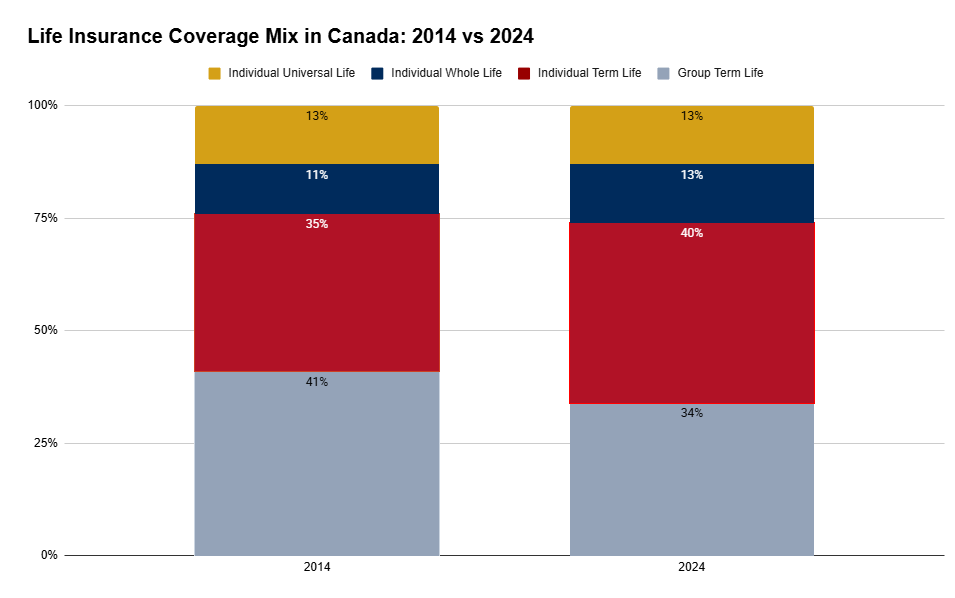
“Individual life insurance now equals 66 per cent of the value of total policies in-force, up from 59 per cent in 2014 – driven primarily by term life insurance.”
Source: Canadian Life & Health Insurance Facts 2025 Edition — CLHIA, page 13
Term life insurance is the most cost effective way to get your family the coverage that they need. This is why term life insurance is driving the growth in individual life insurance ownership. Your beneficiaries are taken care of and the premium is the most affordable.
3. Mortgage / Housing Trends
“Mortgage rules to allow up to 30 year mortgages for first-time homebuyers purchasing new builds.”
Source: Department of Finance Canada — 30 Year Mortgage for First-Time Buyers of New Builds
With longer amortization for mortgages we can see a clear path to why Term 20 and Term 30 policies are so popular. These allow for the large death benefits required to match the length of the need while maximizing the return on the premium dollars invested.
4. Rising Cost of Living & Larger Mortgages
“The increase may be due to individuals needing to cover larger mortgages and higher cost of living.”
Source: Canadian Life & Health Insurance Facts 2025 Edition — CLHIA (Page 13)
In lock-step with longer amortizations there has also been a growth in property values that has lead to many people using term insurance as an affordable way to get high death benefit amounts for reasonable premium costs.
Frequently Asked Questions
- What is the difference between Term 10, Term 20 and Term 30 life insurance?
The length of time before the policy renews is the key difference. The time frame will be 10, 20 or 30 years.
2. Which term life insurance option is cheapest in Canada?
The shorter the term the lower the initial premium will be. When you look over longer periods of time though, typically a longer term policy (20 or 30 years) will have a lower total cost than a Term 10 plan for that same number of years because the Term 10 renewals make it more expensive.
3. Which term length is best for families and mortgages?
Match the term length to the length of the need so using a 20 or 30 year term plan to cover these types of expenses makes the most sense.
4. Is Term 30 worth the higher monthly cost?
If you are covering a long term need then the answer is yes. By avoiding one or two renewals you will save money over the entire time that you need the coverage.
5. What happens when a term life insurance policy expires?
The policy terminates, the policy may renew at a higher premium depending on the insurance contract. Insurance coverage ends when the policy reaches its expiry term or canceled.
6. Can term life insurance be converted to permanent insurance?
If your policy has a convertibility rider/option attached to it then yes, it can be converted to permanent coverage.
7. Which term life insurance option is best near retirement?
Needs tend to be shorter in duration as retirement nears so you see more people at this stage of their lives using Term 10 or occasionally Term 20 policies.
Key Takeaways
- The most obvious difference between Term 10, Term 20 and Term 30 life insurance policies is the number of years that the initial premium is set for before reaching a renewal point.
- The various lengths of term available make matching the amount of time you need the coverage and the length of term policy that you buy easier.
- When policies renew the premium increases, and the amount of the increase often surprises people. Remember, the odds that you are going to pass away after the renewal are higher than they were before simply because you are older. The risk is higher and the premium reflects this.
- Term life insurance is not a great tool for estate planning or final expense coverage because they all have an expiry age attached to them, which varies by policy and insurer.
- If you look at the upfront premium, term 10 will always look the most attractive. Instead look at how long you need the coverage for and figure out the cost associated for the total number of years. If there is one, or even two renewals for a Term 10 plan to cover the duration of your need you are always better off with the longer term plans.
- Term 10, Term 20 and Term 30 policies will provide you with the best way to get the coverage you need for your beneficiaries with a far more cost effective premium than trying to use permanent coverage.
Conclusion
When we look at the differences between Term 10, Term 20 and Term 30 insurance policies what we see is that the amount of time you need the coverage is the key factor in determining the best fit for you. By having the ability to set the premium for 20 or 30 years and match the length of time that your family faces mortgage obligations, income replacement needs and the ability to stay on track financially you can maximize the security you get from your premium dollars. Make sure that you take advantage of talking to a life insurance advisor like the ones at lifeinsurancecanada.com to get the help you need in determining the best fit for the coverage you need and the budget you have.
About the Author
Simon Huften is the President of Life Insurance Canada.com Inc. and has worked in the financial services industry since 2009. He began his career as a financial advisor with Freedom 55 Financial and London Life and now focuses on the online sale of insurance products. Simon oversees the day-to-day operations of Life Insurance Canada.com, including relationships with insurers, wholesalers, brokerages and the company’s advisory team. Learn more about Simon Huften.